


Still early days so would prefer to write on 3 months but think it had already helped my dry eyes. My main priority is an auto immune condition with my thyroid. Hopeful it will help along with nutrition to reduce the antibodies. My sister had one that helped with Adenomyosis. Using it every day reduced the severity and frequency.

Shop with confidence: 365 day money back trial
Target Light 2.0 Handheld Red Light Therapy Device
Target Light 2.0 Handheld Red Light Therapy Device
A dual wavelength red and near infrared light therapy device for skin, eyes, joints, and deep tissue support
Regular price
£260.00 GBP
Regular price
Sale price
£260.00 GBP
Taxes included.
Shipping calculated at checkout.
Includes power cable with E27 screw fitting and switch, and full user guide
10,000+ customers
Free UK & EU shipping
Free Zoom onboarding
 660nm + 850nm
 Face and eyes
 Joints and muscles
 Mains powered
Quantity
Couldn't load pickup availability
137 mW/cm² combined at 10cm
Flicker free technology
LIA lab tested in the UK


Red Light Therapy 660nm 850nm Benefits and Modes
The Science of Depth
Two Wavelengths. Three Targeted Modes.
Targeted Red
660nm
Skin Tone, Complexion and Eye Comfort
Visible red light absorbed at the surface level. Studies suggest 660nm may support collagen processes, skin wellness, and a natural sense of comfort around the eyes.
Deep Near Infrared
850nm
Joints, Muscles and Deep Tissue Wellness
Invisible near infrared light that penetrates deeper into tissue. Research suggests 850nm may support joint comfort, muscle wellness, and cellular energy at a deeper level than red light alone.
Full Spectrum
660nm + 850nm
Total Body Wellness in a Single Session
Both wavelengths working together to support every layer from skin to deep tissue. Combined irradiance of 137 mW/cm² at 10cm for maximum coverage per session.
How to use the Target Light 2.0
01
Deep tissue and joint support
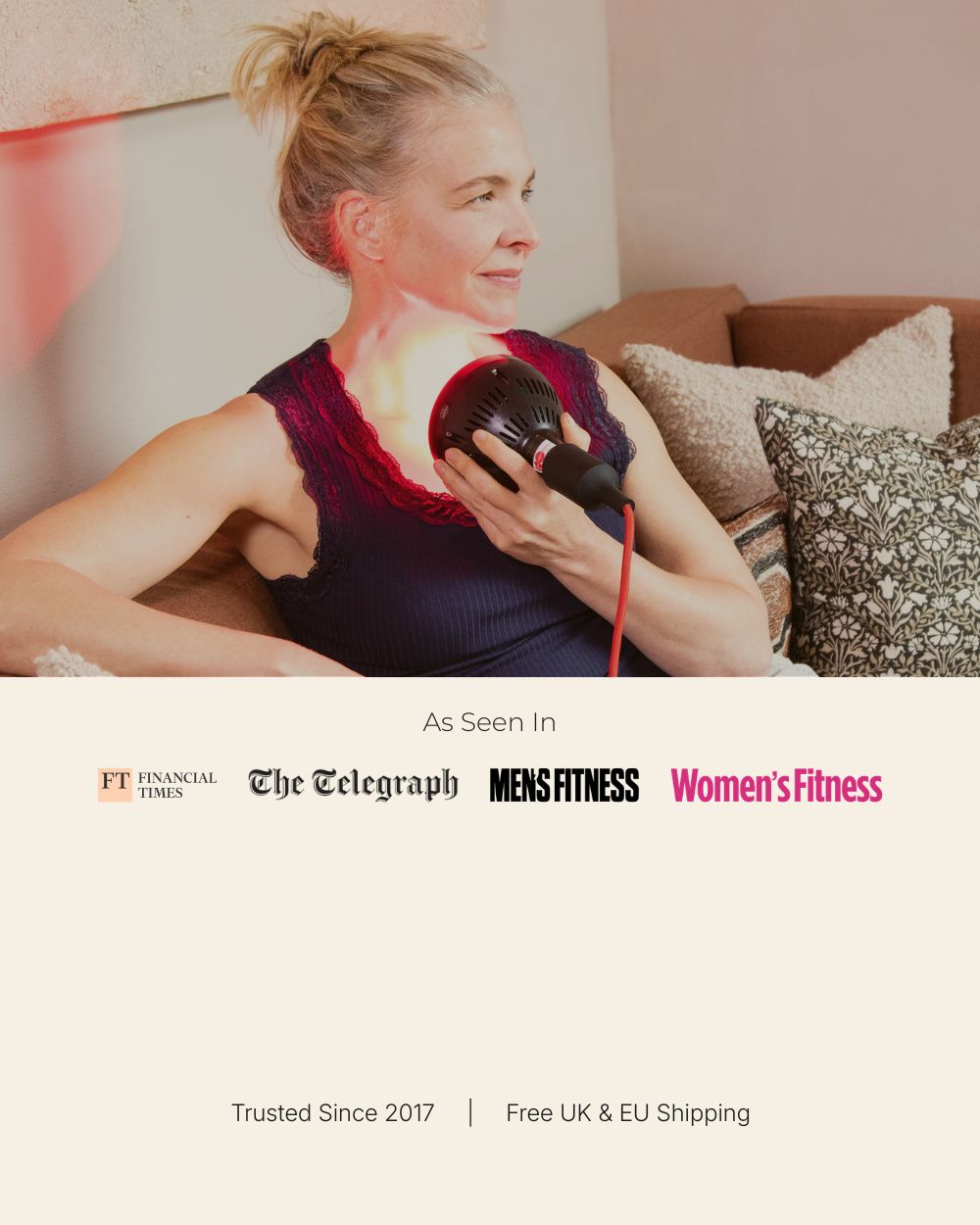
Hold the Target Light 2.0 directly against the skin or within 0 to 5cm for 5 to 7 minutes per area. Switch to near infrared mode (850nm) or full spectrum mode for joints, muscles, and deeper tissue wellness. This close range proximity ensures maximum light absorption where it matters most.
02
Face, eyes, and skin care
Position the device 20cm or more from your face for 5 to 10 minutes. Switch to red mode (660nm) for surface level skin care and eye comfort. Eyes can be open or gently closed, whichever feels most comfortable. The further the distance, the gentler the exposure.
03
Your daily wellness rhythm
Use once or twice daily. Mornings may help set the tone for focus and alertness, while late afternoons or evenings support your wind down routine. The three modes let you tailor each session to your goal — red for skin and eyes, near infrared for deep tissue, or full spectrum for everything in a single session.


Consistency is key. Every order includes a detailed user guide to help you master your routine.
Download the user guideWhat's included
Target Light 2.0 | Power Cable with E27 Screw Fitting + Switch | Full User Guide PDF + Bonus Guides | Free Consultation Calls on Request

1 year warranty
365 day money back trial
Free Zoom onboarding
Technical specifications
Red Light Rising Target Light 2.0
| Wavelengths | 660nm (red) + 850nm (near infrared) |
| LEDs | 48 (14x 660nm red + 34x 850nm NIR) |
| Modes | 3 (red only, near infrared only, combined) |
| Combined irradiance — 10cm | 137.10 mW/cm² |
| Combined irradiance — 15cm | 99.56 mW/cm² |
| Combined irradiance — 20cm | 84.88 mW/cm² |
| Combined irradiance — 30cm | 54.84 mW/cm² |
| Combined irradiance — 50cm | 27.04 mW/cm² |
| Combined irradiance — 100cm | 7.08 mW/cm² |
| All irradiance readings independently tested by the LIA Laboratory, UK (Report P10145A, EN 62471:2008) | |
| Red 660nm irradiance — 10cm | 50.87 mW/cm² |
| Red 660nm irradiance — 30cm | 21.21 mW/cm² |
| NIR 850nm irradiance — 10cm | 86.23 mW/cm² |
| NIR 850nm irradiance — 30cm | 33.63 mW/cm² |
| Individual wavelength readings at key treatment distances for reference | |
| Rated wattage | 48W |
| Real wattage (LIA tested) | 35.54W |
| EMF (magnetic) at 15cm (6 inches) | 0.2 mG |
| EMF (electric) at 15cm (6 inches) | 73 V/m |
| EMF measured using TriField TF2 meter on non-conductive surface. Device warmed up before reading. | |
| For a full explanation of these readings and what they mean, see the EMF question in our FAQ section below. | |
| Flicker | Flicker free (LIA tested) |
| Safety certifications | CE, ROHS |
| Dimensions | 150mm × 120mm |
| Weight | 383g |
| Casing | Aluminium + plastic |
| Cooling | Built in fan (60mm × 60mm × 10mm) |
| Coverage area | Face, eyes, single joint, or targeted body area |
| Power supply | 230V AC 50Hz mains powered |
| Fitting | E27 screw (cable with switch included) |
| Warranty | 1 year (covers manufacturing faults only) |
| Trial period | 365 day money back trial |
Independently tested by the UK Lighting Industry Association
The Target Light 2.0 has been independently tested by the LIA Laboratory in the UK, an accredited testing facility operated by the Lighting Industry Association.
Irradiance was measured separately for both the 660nm red and 850nm near infrared wavelengths using a Bentham IDR300 double monochromator to standard EN 62471:2008, with readings taken at seven distances from 10cm to 150cm. Flicker was tested to PD IEC TR 63158:2018 and confirmed at 0.3% with a flicker index of 0.
Unlike many red light therapy devices that rely on in house testing, every irradiance and flicker figure on this page is independently verified by a UK laboratory.
Download the full LIA lab report (PDF)
Spectral output at 100mm — dual peaks at 660nm and 850nm

Irradiance results at seven distances (10cm to 150cm)

Backed by research
The wavelengths used in the Target Light 2.0 — 660nm and 850nm — are two of the most frequently studied in red light therapy and photobiomodulation research. Studies suggest that 660nm red light may support skin wellness and eye comfort by interacting with cytochrome c oxidase at the surface level, while 850nm near infrared light penetrates deeper into tissue where it may support joint comfort, muscle wellness, and cellular energy production. Peer reviewed research continues to explore the role of these wavelengths across a wide range of wellness applications.
Read more about the science →Is the Target Light 2.0 right for you?
This might be right for you if...
- ✓ You want both red and near infrared wavelengths in a single handheld device for skin, eyes, joints, and muscles
- ✓ You want targeted support for specific joints — knees, shoulders, wrists, neck — with near infrared light
- ✓ You want to support your skin tone, complexion, or eye comfort with 660nm red light
- ✓ You want three switchable modes (red only, near infrared only, or combined) to tailor each session
- ✓ You want a mains powered device with no battery to charge or replace
- ✓ You want higher combined irradiance than a single wavelength device (137 mW/cm² at 10cm)
- ✓ You value independently tested irradiance and flicker data from a UK laboratory
This might not be right for you if...
-
✗
You only need a single wavelength for face, eyes, and skin care without near infrared
→ Consider the Target Light 670 -
✗
You need a battery powered device you can use anywhere without a power socket
→ Consider the Target Light 3.0 -
✗
You want three wavelengths including 810nm for the widest range of applications
→ Consider the Target Light 3.0 -
✗
You want to treat large areas like your full back, legs, or torso in a single session
→ Consider an Advantage panel -
✗
You're looking purely for a circadian lighting or ambient sleep lamp
→ Consider the Dusk Lamp
Customer Reviews
Overall rating: 4.8 / 5 from 122 reviews.

I purchased this light after it was recommended to me by a friend. It came quickly and well packaged. I've been using it for a couple of weeks now on the back of my neck and shoulder blades. It eases the aches I have there and the warmth from the light helps too. I'm hoping over time I'll feel lasting relief. The light is well made. So far I am very happy with it.
Red Light Rising Target Light 2.0 Handheld Red Light Therapy Device
We bought this red light to replace our old one and you can certainly tell the difference!! It's a lot more powerful and we love the infrared setting as well. We also got the blue light blocking glasses and dusk lamp which will come in really handy for when we have to do those late night nappy changes ready for our new born in July! It's a sleek design and obviously a quality product.
Red Light Rising Target Light 2.0 Handheld Red Light Therapy Device
I bought this product for my elderly Mum. I think it will take time to make a difference but so far so good.
Easy to use
I'm not sure yet which is why I only gave it 3 stars...too early! I imagine any improvement in skin or sleep would take some time to show?! But I have fingers firmly crossed that it will be great.
Great device!

Me encanta! Tiene 3 posiciones, luz roja e infraroja, solo luz roja y al final infraroja solo.
Hello! Yes, I received the lamp, and I’m absolutely thrilled! It’s a wonderful lamp and the quality is excellent. I will definitely write a review, but in a few weeks, as I don’t want to just praise the product—I want to share my actual results from using it. Just a compliment is boring, but results are what really matter.
I love it. It's still too early to talk about noticeable results, but the light is beautiful, it fills the whole room, and I feel more relaxed. I've been using it for two weeks now, and I might already be sleeping better.
I have only used it three times so it’s too early to say whether it was effective for pain relief. Hence 4 stars as too early to give a comprehensive review but keep receiving requests to leave review. Easy to use out of the box. Fingers crossed.
This is day 6. The pain in my knees is no longer sharp. The nerve pain from my L5 disc seems significantly improved. It usually feels like a shot of electricity and was debilitating. 10 minutes on each area twice a day. I am in disbelief now. Almost 2 weeks in now and this coming week I intend to slowly start to reduce my pain meds. I just cannot believe this and wish I had discovered this 2 years ago. I have not been able to walk properly for nearly a year. I live in a small space so the hand held lamp is perfect for me so far. Thank you.
Im so happy with my purchase ...it doesnt heat up like my previous red light lamp. The product arrived within 2 days of ordering ...such a fabulous service , thankyou . Im going for a panel next !! Its so good.
Love my lamp. I use it first thing in the morning as I have slightly dry eyes. I find that if I don’t use it my eyes are sore and, I’ve noticed that my skin has got quite plump and glowy. I’ve also noticed that I’m in a more positive frame of mind for the day. Brilliant results for 10 minutes a day.
I bought the red light to help my ankle and calf as I’m suffering from tendinitis, I’m not sure how much it’s helping but I’ll give it a while longer and see how it goes. Regards, Linda Jones
Really good can feel the power however such a shame they haven’t produced some kind of stand or holder and a button for each setting however am very pleased with it so far.
Another great product from RLR - wonderful quality, easy to use, I’m enjoying this red light very much - highly recommended.
Received this item for My Birthday and I’ve been using it on My back and knees due to suffering with deep tissue pain and so far it’s working, each day it feels like my body is recovering a lot faster with the red light therapy.
Solid build, I've managed to make a good rig out of a music stand. Easy to use- the single switch allows for multiple settings, however, I would say, given it is IR and NIR, it would have been incredibly helpful to include a card on the the different settings with suggested distance/times for different uses or body parts. Instead, I'm finding myself Googling it and hoping that the algorithm feeds me something trustworthy!
Thanks! 💪🏽
Pleasant warmth and very easy to use. Not sure it worked for me but possibly not the right type of injury (I now suspect more bone than muscle)
I bought the target light as a gift for a friend that I had already recommended it to him. Therefore the last purchase was not for myself. However, I have one that I bought many years ago and I use regularly and am very happy with it.

I was quite apprehensive from the beginning. So I used the lamp just for cosmetic reasons on my hands, but when, to my great surprise, years long carpal tunnel syndrome symptoms suddenly disappeared, I couldn’t believe it. From that very moment, I’ve been converted. Now contemplating to buy a big panel. Also after care service is superb! Highly recommend!
It was really good “ only problem with me was having to hold it by hand. Really well made but heavy if you just hold it , would have been better having a support so you could sit under it . John
Relax experience
The red light 2.0 lamp is super easy to hold and use. I’m feeling great after using it.

An excellent product, plug & play, highly effective already after a few times use from a customer-friendly company.
Easy to use and light to hold
I’ve been using the target light for years now and absolutely love it. It really works. I use it every morning, and it fully wakes me up and leaves me feeling energised for the day. I also notice real improvements in my skin when I use it regularly, which I love. I’m such a fan that I tell everyone about it! If someone mentions any aches or pains, I’m straight in telling them about the red light! Bryan has been incredibly knowledgeable and super helpful whenever I’ve had questions, which made the whole experience even better. I honestly can’t recommend Red Light Rising enough!
Early days yet, using twice daily for long-term knee injury. Hoping that it will lead to permanent cure, some improvement after two weeks. Will provide further update in due course.
Amazing
This is my first purchase and I do think it’s already helping with my shoulder impingement issues and it’s quite relaxing to have to sit still for a few minutes!
I like it but haven’t used it for long enough yet
So impressed with the handheld device I purchased the half stack version. Feeling energised! 😁
I already had a Target Light 2.0 and was very pleased with it but I gave it to my Daughter for her to use as her need was greater than mine, so I had to purchase another as I didn’t want to be without one for too long. I use it for my eyes and other things, my vision has improved and I’m free of headaches now. I also have an Advantage 900 that I use on my spinal problem and Body in general, for keeping me pain free. My 2 Wraps also comes in very handy. I’m a great believer in RLR! And they are not expensive for the good they do. George Baker
Bought this lamp as a replacement for one that got broken.
It's not working on my muscle pain.
this is my second unit, I gave my first one to my son with Rhuematoid Arthritis, who seems to benefit. I have OA in my knees, neck and back, and it definitly helps. Would recommended to you
Prima lamp die zeer krachtig is. Absoluut tevreden met mijn aankoop!
Annoying that some basic instructions arn't included in the parcel - means you can use it straight away without logging on to something, phone pc etc.... I saw how to use the hand held light on Near Infrared and Red Light somewhere but now can't find that info. Info seems to be all over the place and needs to be studied (fine) but no quick reference slomewhere - ideally paper based..sorry but personally that would suit me!!
Frequently asked questions
01
What is the difference between the three modes on the Target Light 2.0?
−
The Target Light 2.0 has three modes that you can switch between depending on your goal.
Red mode (660nm only) activates only the visible red LEDs. This mode is best suited for surface level wellness — skin care, complexion, eye comfort, and relaxation. Use it at 20cm or more from your face for 5 to 10 minutes.
Near infrared mode (850nm only) activates the invisible near infrared LEDs. This mode is designed for deeper tissue support — joints, muscles, and cellular wellness below the surface. Hold the device directly against the skin or within 0 to 5cm for 5 to 7 minutes per area.
Combined mode (660nm + 850nm) activates both wavelengths simultaneously, delivering a combined irradiance of 137 mW/cm² at 10cm. This mode is ideal when you want to support both surface and deep tissue wellness in a single session.
02
What is the difference between the Target Light 2.0 and the other handheld devices?
+
The Target Light 670 offers 670nm red light only for face, eyes, and skin. Mains powered, £119.
The Target Light 2.0 (this device) adds 850nm near infrared for deeper tissue support alongside 660nm red, with three switchable modes. Mains powered, combined irradiance of 137 mW/cm² at 10cm, £239.
The Target Light 3.0 adds a third wavelength (810nm), rechargeable battery, touchscreen controls, and a carry case. Maximum portability and versatility, £289.
The Target Light 4.0 is a professional grade spotlight for clinics and advanced home users with a built in floor stand and significantly higher irradiance.
For full body coverage, explore our Advantage red light therapy panels.
03
How close should I hold the Target Light 2.0 and for how long?
+
The recommended distance depends on what you are targeting.
For joints, muscles, and deep tissue support, hold the device directly against the skin or within 0 to 5cm and use near infrared or combined mode for 5 to 7 minutes per area. The closer the device, the higher the irradiance delivered to the tissue.
For face, eyes, and skin care, position the device 20cm or more from your face and use red mode for 5 to 10 minutes. Eyes can be open or gently closed, whichever feels most comfortable.
You can use the Target Light 2.0 once or twice daily. Morning sessions may help set the tone for the day, while evening sessions support your wind down routine.
Every order includes a detailed user guide with session recommendations for different wellness goals.
04
Some of my LEDs don't appear to be on. Is my device faulty?
+
This is completely normal and your device is working correctly.
The Target Light 2.0 contains two types of LEDs — 14 red LEDs at 660nm and 34 near infrared LEDs at 850nm. The 660nm red LEDs produce a bright, visible red glow. The 850nm near infrared LEDs, however, emit light that is almost entirely invisible to the human eye. They may appear very faintly lit or completely off, but they are delivering near infrared energy into your tissue.
This is not a fault — it is actually a sign that your device is producing genuine near infrared light at the correct wavelength. If the near infrared LEDs appeared bright red, it would suggest they are not emitting true 850nm light.
To confirm your device is working, switch to near infrared only mode in a dark room and look at the device through your phone camera. Most phone cameras can detect near infrared light and will show a faint purple or white glow from the LEDs that appear dark to the naked eye.
05
Is the Target Light 2.0 safe to use near my eyes?
+
Yes, the Target Light 2.0 can be used near the eyes in any of its three modes, but the recommended distance varies.
In red mode (660nm), position the device 20cm or more from your face for 5 to 10 minutes. You can judge the intensity by how bright the light feels on your eyes. If it feels too bright, simply move the device further away. Eyes can be open or gently closed.
In combined mode or near infrared mode, we recommend a minimum distance of 65cm (roughly arms length) from your face. The near infrared wavelength (850nm) is invisible to the eye and delivers significantly more energy than the red LEDs, so it is difficult to gauge the intensity by looking at the device. At arms length the exposure is gentler and more comfortable for the eyes. In this scenario, less is more.
The device has been independently tested for flicker by the UK Lighting Industry Association and confirmed as flicker free, which is particularly important for use near the face and eyes.
If you have specific eye concerns or pre existing conditions, we recommend consulting a healthcare professional before starting.
06
What does flicker free mean and why does it matter?
+
Flicker refers to rapid, often invisible fluctuations in light output caused by the way some LED devices handle electrical current. Even when flicker is not visible to the eye, it can contribute to eye strain, headaches, and general discomfort, particularly during close range use.
The Target Light 2.0 has been independently tested by the UK Lighting Industry Association and confirmed as flicker free, with a flicker percent of just 0.3% and a flicker index of 0.
Many competitors do not publish flicker data at all, so if you are comparing devices, we recommend asking for independently verified flicker test results.
07
How do I know the irradiance figures are accurate?
+
All irradiance figures for the Target Light 2.0 were measured by the Lighting Industry Association (LIA) Laboratory in the UK, an independent accredited testing facility.
The testing was conducted using a Bentham IDR300 double monochromator to standard EN 62471:2008, and the full results are published in LIA Report P10145A. Both the 660nm red and 850nm near infrared wavelengths were measured separately at seven distances from 10cm to 150cm.
We provide individual wavelength readings and combined totals so you can see exactly what the device delivers in each mode at your preferred treatment distance.
Many red light therapy brands publish only a single irradiance figure at one distance, often measured in house. We believe independent, dual wavelength, multi distance testing gives you a more honest and complete picture of what you are buying.
08
What are the EMF levels on the Target Light 2.0?
+
At 15cm treatment distance, the Target Light 2.0 measures 0.2 mG magnetic field and 73 V/m electric field using a TriField TF2 EMF meter.
The magnetic field is excellent at 0.2 mG — well under the Building Biology "no concern" threshold of 1 mG. This is particularly notable because the TL 2.0 has a built in cooling fan, which can sometimes contribute to higher magnetic readings. At treatment distance, the fan has no measurable impact.
The electric field reading of 73 V/m is elevated compared to our panel devices, which is typical of mains powered handheld products where the power supply sits close to the light source. Typical household electric fields range from 1 to 100 V/m in most living spaces, so the TL 2.0 falls within the upper end of normal domestic levels. If you are specifically trying to minimise electric field exposure, the battery operated Target Light 3.0 produces zero detectable EMF across all measurement modes.
It's worth bearing in mind that every electronic device you use in daily life produces some level of EMF — your phone, your TV, your kettle, your fridge, your Bluetooth headphones, your fitness tracker. EMF is a normal part of modern life and virtually impossible to avoid entirely. The additional EMF exposure from a red light therapy session is small in the context of everything else you're already exposed to, and we believe the wellness benefits of consistent use far outweigh any concern about the modest EMF levels involved.

Trusted since 2017
The UK's original red light therapy brand, supporting customers across the UK and Europe

365 day trial
Try any panel or handheld device for a full year, risk free

Over 10,000 customers
Real results from real people across the UK and Europe

Free Zoom onboarding
Every order includes a free personal consultation to help you get the most from your device